Tending
Hi!
It’s been a minute.
Or six months, if you’re counting.
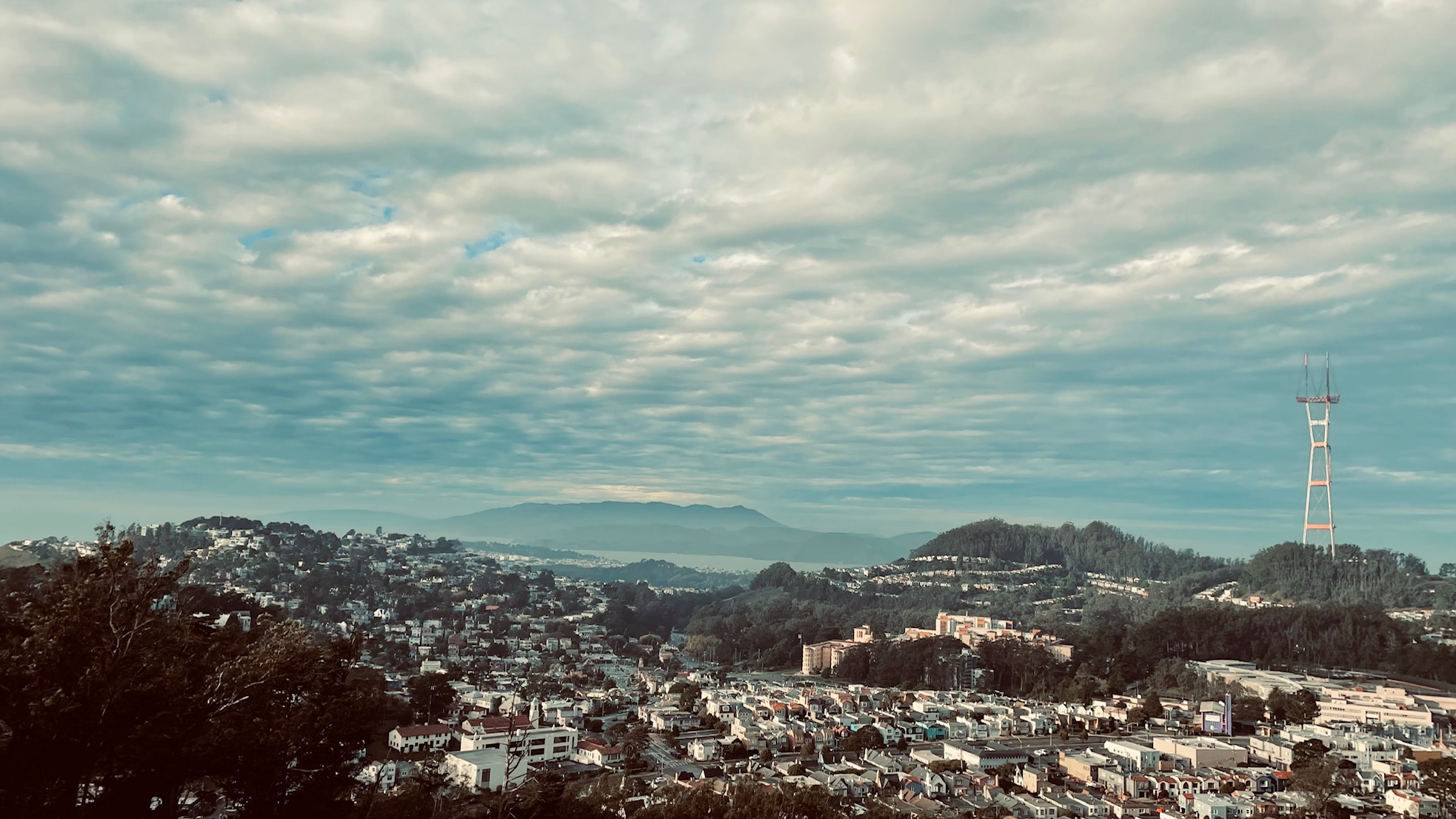 Sutro Tower, San Francisco.
First, a few logistical matters. Those of you who have been around a while will notice some visual changes. Last month I migrated my newsletters over to Buttondown after a less-than-stellar experience with Convertkit.
I’ve been really happy with the service so far, though I am still figuring out how to customize the templates so you’re getting a kind of out-of-the-box experience right now.
But what I really wanted to share about this new arrangement is that Buttondown allows me to turn off tracking pixels. I am happy to say that now both my website and my newsletters do not track you. I have no clue if you open or read the newsletter, what you click on, or anything else for that matter and I am thrilled to not know. The only thing I have insight into is deliverability and who unsubscribed. But really just deliverability because I don’t check unsubscribes—you have every right to go whenever you want to and I do not need to know that you have gone.
So yeah, about that six months thing.
2023: Late summer transitioned to early fall and work commitments took over. Nothing out of the ordinary, some interesting work and lovely people to collaborate with on topics that I care about but then… October happened.
The essays I had been working on suddenly felt faded and musty, old letters forgotten in the attic for decades, quaint and for the most part irrelevant to what the world had become. It felt impossible to write. The only thing I could write about was grief.
What I have come to realize in my own process this fall is that grief is important and necessary. As my colleague Katherine McCabe says, “we must all become grief warriors.” Grief is action, grief is the necessary step to accept where we are and let the reality of that place flow through us.
I wasn’t the only one whose writing practice changed. Ben Ehrenreich writes in Issue 1 of Flaming Hydra:
And though writing has been the tool that in the past allowed me to crawl through every darkness, I have had a hard time writing my way through this one. Or writing at all. Or even imagining the possibility of seeing through it to some other side. What other side could we consent to live in if it was in any way continuous with this?
I was also reminded of Daniel Schmactenberger’s advice for living in trying times: feel depressed. He elaborates, “you should feel depressed. If you don’t you are a psychopath.” His comment was a reference to the metacrisis, which makes the sentiment broadly applicable to whatever terrible thing you choose as your particular depression du jour.
But there is wisdom in this—in grief and depression and the understanding of what these important emotions want to share with us. And it is also necessary to be exactly where we are, here, in the middle of it all and know that this is where we are. We cannot pretend to be anywhere else—as long as we do our responses will be incongruent and inadequate.
Finding ourselves in the middle of it all is uncomfortable. It wasn’t supposed to happen this way, and yet here we are. When I stopped writing this fall, “it all” was the attack on Israel and the subsequent and ongoing genocide of the Palestinian people.
Other times “it all” is the violence of unregulated capitalism and white supremacy, industrialized ways of living that have pushed us well beyond sustainable planetary boundaries, the rabid desire to control women’s bodies, erasure of trans rights and trans people, the neoliberal project, rising fascism, cynicism, the entrenchment of the billionaire class, the war against poor people, racism and anti-Blackness, and rampant ongoing settler-colonialism. To name a few.
A common response is to ask, “Well, what do we do? What can be done? How do we fix this? ” We turn to action to shield us of the discomfort of seeing our own complicity. But this action, when taken from an unchanged place of being, extends the logic of known knowns and clear categorization in service of solutions.
By “unchanged place of being” I mean this: we are shaped by the systems we grew up in—society, family, religion, education, etc.—and for the most part that shaping feels like how the world really is. If we cannot see this shaping and begin to interrogate it not as reality but as a system of living that defines our being, then actions we take will extend the logic of the system because we are of the system and created by the system. If we do not see this we have no choice but to perpetuate it.
So we come to action from an unchanged place of being, seeking to know what got us here so we can get ourselves out. To this end we take a snapshot of the world and dissect it to fuel our analysis so that we can know. But the snapshot is not the map is not the territory, and when we forget this we end up mistaking our abstractions for reality. We believe we have solid ground to stand on, but the brittleness of our analytics constructions cannot hold weight.
“The impatient idealist says: ‘Give me a place to stand and I shall move the earth.’ But such a place does not exist. We all have to stand on the earth itself and go with her at her pace.” ― Chinua Achebe, No Longer at Ease
To come from a changed place of being we have to stand on the earth. We have to get wise to our own shaping and the systems that have done that shaping. We have to accept what we have created and where we are, and we have to grieve everything we have lost.
For me the last many months have been a lot of the above — feeling the feels and standing on the earth and interrogating my own shaping. And letting that be an okay place to be because that’s where I was.
It is not lost on me that all of this coincided with the winter months here in the northern hemisphere. The short days and long nights invite inward movements of reflection, the stillness and dormancy of the seed as it prepares for germination in the early days of Spring.
Having recently passed Imbolc, and with the days getting longer, something is stirring in me again. I have more clarity and commitment to what this newsletter wants to be and what it is part of: a line of work that will cover years, maybe decades, perhaps even the rest of my life. On my (now archived) research page I talked about this work as:
“… one of scholarship but also of healing, weaving, and integrating. I seek to understand the ways in which we have deworlded ourselves from nature, how our neurobiology became complicit with technology to abstract us from the feedback loops critical to our connection with each other and with the more-than-human world. And to also understand the practices of tending that bring us back into right relationship with our brain, soma, technology, and nature so that we can remember the deeply spiritual role we play as an integral part of the Gaian system.”
Worth Your Attention
Dialogue is the art of attuning to what is present in “the field”—the merging of experience through the practice of conversation—sharing ideas through explicit interactions. Emergent vs Transactional Conversations is a variation on this theme with a particular orientation to work, and exposes why some conversations are co-creative, energizing, and emergent while others are flat, predictable, and uninspiring.
In the Shadow of Silicon Valley—Rebecca Solnit brings the fire to the techno-accelerationist transformation of Northern California. I appreciate this piece because of the way Solnit uses stories and personal narrative rather than abstractions and theory as she traces the history of our current moment through the semiotics of self-driving cars (one of which was torched during the Lunar New Year celebrations here in SF).
Emergence is definitely a theme here at the becoming. To that end I would be remiss not brining attention to Max Cooper’s Emergence project, a piece of work exploring emergence across multiple mediums and formats including an album, live shows, storytelling, and audio and visual content. Starting from before the big-bang and taking us up to the present moment, the explorations and collaborations are rich, mesmerizing, and thought-provoking.
If you don't want to or currently can't dedicate the time to reading Iain McGilchrist's two volume series “The Matter With Things: Our Brains, Our Delusions, and the Unmaking of the World,” then be sure to check out David McIlroy’s summary over at Perspectiva.
On Tuesday I start a 7 week course, Seeing Through the World: Jean Gebser and Integral Consciousness. I’ve been wanting to take this course since I first heard Jeremy Johnson talk about Gebser’s work, which feels so directly related to what I am exploring here at the becoming. Johnson writes, “The future lives in us. In this moment of civilizational crisis, Gebser’s time has come yet again to help us navigate a liminal age of worldview transition. We must learn to be sufficiently present in order to live the future that is already living us.” I believe enrollment is still open!
Thanks for sticking around ❤️.
Andi